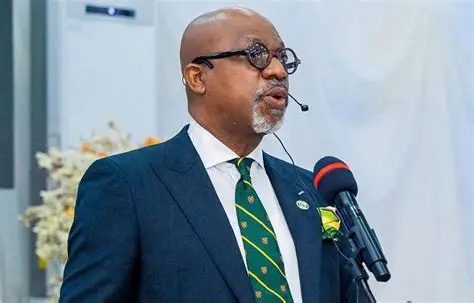
Chairman of the Southern Governors’ Forum and Ogun State Governor, Dapo Abiodun, has said that Nigeria requires an additional 554,353 police personnel to adequately staff the proposed state police system,
He disclosed this on Thursday while delivering a keynote address at the posthumous 70th birthday colloquium of former Ondo State Governor, Oluwarotimi Akeredolu, held at the International Conference Centre, University of Ibadan, Oyo State.
The colloquium, themed “Fundamentals and Governance of State Policing: Towards a New Architecture for National Security in Nigeria,” brought together governors, former governors, lawmakers, security chiefs, traditional rulers, academics and other stakeholders to discuss the future of policing in the country.
Abiodun said the proposed state police system had moved beyond advocacy to become a national necessity, stressing that its success would depend on a sustainable funding arrangement that ensured all states could maintain an effective policing structure.
Citing data from the Nigeria Governors’ Forum and the United Nations benchmark of one police officer to 414 citizens, he said Nigeria would require 554,353 additional personnel, translating to approximately 184,784 recruits annually over three years.
“The debate is no longer whether Nigeria needs state police, but how swiftly and sustainably we establish it,” he said, arguing that the country could no longer sustain a security structure in which policing responsibilities were excessively centralised in Abuja.
According to him, security is inherently local, making it necessary for officers to understand the languages, culture and terrain of the communities they serve.
He maintained that state policing would strengthen national stability rather than threaten the country’s unity.
The Ogun governor, however, warned that significant disparities in states’ revenue-generating capacities could undermine the initiative if adequate funding arrangements were not established.
He disclosed that Lagos, Rivers, the Federal Capital Territory, Ogun and Enugu accounted for 61.6 per cent of Nigeria’s internally generated revenue, while 76 per cent of states generated below the national average of ₦13,600 per capita. He added that half of the states generated less than ₦6,334 per capita.
Abiodun warned that inadequate funding of security in poorer states could have nationwide consequences, insisting that insecurity in one state could spill over into neighbouring states and the wider federation.
He consequently proposed a constitutional state police take-off fund featuring equal-access grants, needs-based financial support and disbursement tied to established standards.
He also disclosed that the Presidential Working Group was developing operational frameworks, financial models, accountability mechanisms and legislative oversight arrangements for the proposed system.
These, he said, would cover recruitment, training, governance and procedures for addressing abuses.
On recruitment, Abiodun called for transparent processes, thorough screening and representation that reflected the diversity of communities. He stressed that officers must receive adequate training in criminal investigation, evidence handling, lawful arrest, conflict management, proportionate use of force and the protection of vulnerable persons.
He further cautioned against political interference, insisting that police protection must be available to every citizen regardless of political affiliation.
“Political opponents, journalists, peaceful protesters and minority communities deserve equal protection,” he said, adding that disagreement with a government must never diminish a citizen’s rights.
Abiodun also emphasised the need for improved welfare for police personnel, including regular salaries, adequate equipment, medical care, insurance and reliable support for their families.
He maintained that welfare, discipline and accountability must develop together, while funding arrangements should sustainably cover salaries, training, maintenance, communications, investigations and equipment replacement.
The governor further warned that private interests must not be allowed to dictate police operations, noting that security trust funds could supplement public financing only under clear rules and with adequate public accountability.
He argued that national security extended beyond physical protection to economic, food, health and financial security, as well as freedom of worship.
“We cannot build a $1 trillion economy on fragile security,” he said, explaining that insecurity discourages foreign investment, threatens agricultural activities and undermines the returns on infrastructure investments.
Abiodun also credited Akeredolu with advancing the state policing debate from theory to practical regional action, particularly through his role in establishing the Western Nigeria Security Network, popularly known as Amotekun, on January 9, 2020.
In his remarks, Ondo State Governor, Lucky Aiyedatiwa, said Akeredolu’s advocacy for state police had progressed from a regional campaign to the centre of Nigeria’s national policy and constitutional discussions.
Aiyedatiwa, who served as Akeredolu’s deputy before succeeding him, described the late governor as a leader who regarded public office as an opportunity for service rather than a symbol of status.
He said the establishment of Amotekun demonstrated that communities closest to security challenges needed a meaningful role in protecting themselves.
Aiyedatiwa stressed that Nigeria must develop a policing system that was responsive, professional and accountable while safeguarding citizens against abuses.
Former Ekiti State Governor, Dr Kayode Fayemi, also paid tribute to Akeredolu, describing him as a courageous leader whose commitment to justice and decentralised security had outlived his tenure.
Fayemi said Akeredolu’s contributions to the South-West extended beyond establishing a security outfit to demonstrating how regional cooperation could address challenges confronting individual states.
Similarly, the Director-General of the DAWN Commission, Dr Seye Oyeleye, called for a shift from commemorating Akeredolu’s contributions to implementing a workable state police system.
Oyeleye said the central questions were how state police would be funded, trained, equipped and regulated, as well as how the system would be protected against political abuse.
He emphasised that state policing was not a regional or ethnic agenda but a national imperative arising from Nigeria’s federal structure and security challenges.
Tighten the story for print
Make the headline more compelling
Strengthen the opening paragraphs