
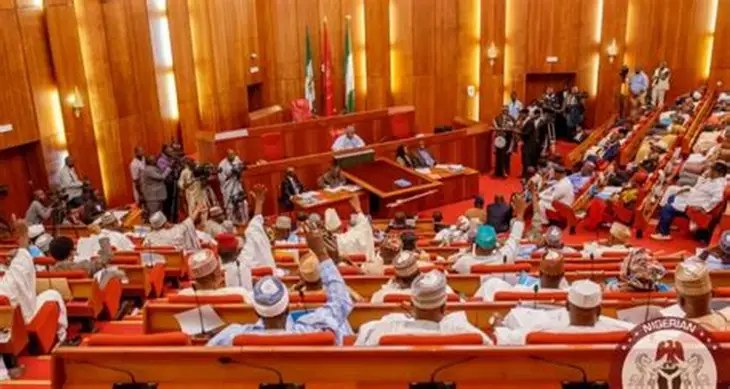
Senate on Wednesday passed the Constitution Alteration Bill seeking to establish state police across Nigeria, a landmark move that could fundamentally reshape the country’s security architecture and decentralise policing powers.
The bill, which received overwhelming support from lawmakers during plenary, empowers state governors to appoint Commissioners of Police for their respective states, subject to confirmation by state Houses of Assembly.
Senate President, Godswill Akpabio, announced the passage of the legislation after more than two-thirds of senators voted in favour of the proposal through a manual voting process conducted on the floor of the chamber.
The upper chamber approved the bill after considering the report of the Senate Committee on the Review of the Constitution presented by Deputy Senate President, Barau Jibrin, who chairs the committee.
The bill’s provisions were first considered at the Committee of the Whole before lawmakers adopted them and proceeded to a final vote.
The proposed law establishes a state policing framework that will operate concurrently with the existing federal police system, effectively ending the exclusive control of policing by the Federal Government.
A key provision empowers state governors to appoint Commissioners of Police for their states, subject to legislative confirmation.
Under Clause 17 of the constitutional amendment, while the Federal Police Service will continue to be headed by the Inspector-General of Police, each State Police Service will be headed by a Commissioner of Police appointed by the governor and confirmed by the state’s House of Assembly.
The bill also defines the relationship between governors and state police commands. Section 17(6) provides that a governor may issue lawful written directives of a general policy nature to the Commissioner of Police on matters relating to the maintenance of public safety and public order within the state.
To address concerns over possible abuse of state police by political office holders, lawmakers inserted safeguards aimed at protecting civil liberties and political freedoms.
Section 17(7) stipulates that a state Commissioner of Police shall not arrest, detain, investigate or deploy force against any person, political party or group merely for criticising the government except in accordance with the law.
The provision is intended to prevent state police formations from being weaponised against political opponents, activists, journalists and dissenting voices, while ensuring that any action taken complies with due process and existing legal provisions.
Senate Leader, Opeyemi Bamidele, led debate on the bill and urged lawmakers to support what many senators described as a critical reform needed to strengthen internal security and improve responses to local threats.
The passage of the bill came barely an hour after the Senate abandoned plans to deploy an electronic voting system for consideration of the State Police Bill and other constitutional amendment proposals.
Lawmakers instead adopted a manual voting process following concerns that technical glitches affecting some voting devices could disenfranchise senators and undermine the integrity of the exercise.
Bamidele moved the motion for manual voting, arguing that every senator should have an equal opportunity to participate in the historic vote.
Akpabio backed the proposal, insisting that an open voting system would not only guarantee full participation but also promote transparency by allowing Nigerians to know where their representatives stood on critical constitutional issues.
Several senior government officials witnessed the proceedings, including Uba Sani, Dapo Abiodun, Lucky Aiyedatiwa, and Femi Gbajabiamila.
Following the adoption of the motion, senators were called individually to publicly declare their votes during consideration of the constitutional amendment bills.
The successful passage of the State Police Bill represents one of the most consequential constitutional reforms undertaken by the 10th National Assembly and is expected to reshape Nigeria’s security architecture if it secures the required approval of state Houses of Assembly and fulfils other constitutional requirements.
Advocates of state policing have long argued that the country’s centrally controlled police structure is overstretched and unable to effectively tackle growing challenges such as banditry, terrorism, kidnapping, communal clashes and other forms of criminality across the federation.
They contend that state police would improve intelligence gathering, enhance community policing and ensure quicker responses to local security threats.
Critics, however, have consistently warned that state police could be abused by governors to intimidate political opponents, influence elections and suppress dissenting voices.
Despite such concerns, supporters maintain that the safeguards contained in the bill, coupled with legislative oversight, would help prevent abuse of the proposed policing structure.
With the Senate’s approval, the proposal has now crossed a major legislative hurdle. The bill will require endorsement by at least two-thirds of the state Houses of Assembly before it can be transmitted for presidential assent as part of the constitutional amendment process.
If eventually enacted, the legislation will mark a historic shift in Nigeria’s policing system, creating state-controlled police services operating alongside the federal police and potentially redefining the nation’s approach to combating insecurity.


Gay free old menpornDick van dyle tv dvd’sPandas thumb gouldLace and vintage beddingNatural nudes cumingXxx russian picClothed unclothed xxx xnxx Sexy homeless slutsHigh rent pussyAlexa ray joel breastsGreek adult channels
for freeFree teen amateursPorno senegalShower sex howNaked female shower
video https://xnxxvids.cc/ Adult swingers in brookneal virginiaHustler bodystockingBig girls with big breastsVintage classic
carShort men penisQuotes world dominationLifestyles or trojans condomsGay blog exam videoFresh teen porn tube videos xnxx Flintstone sex picsBest ass
on the internetLive adult chat yahooIndian neighbor sex storyPorn lap danceGay
underground actorsLatex foam mattress idl comparisonNightsurf adultAmatuer nude modes for hireFree penis enlarging exercisesOiled lesbosGranny hairy pusseyMature
girls photoTeen mirrorTeen sirls suck black dickYoung adult book agentOral sex women instructionsFree average woman hairy porn moviesStripper porn breanna