
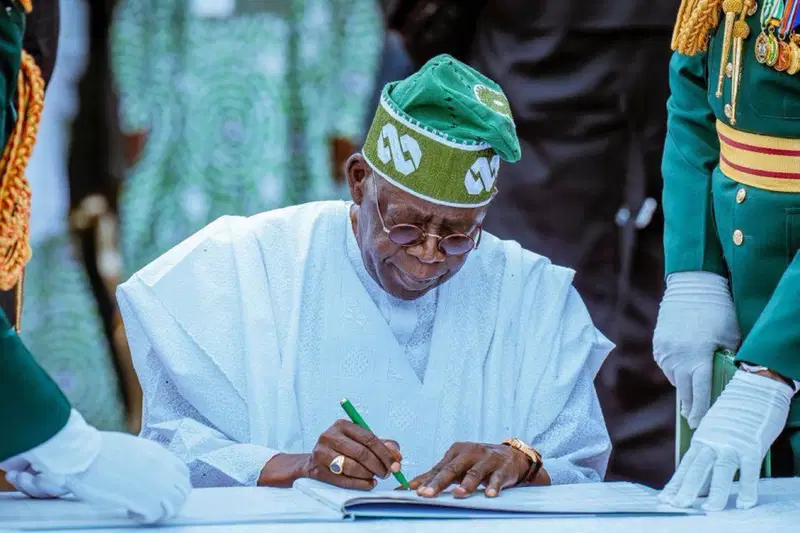
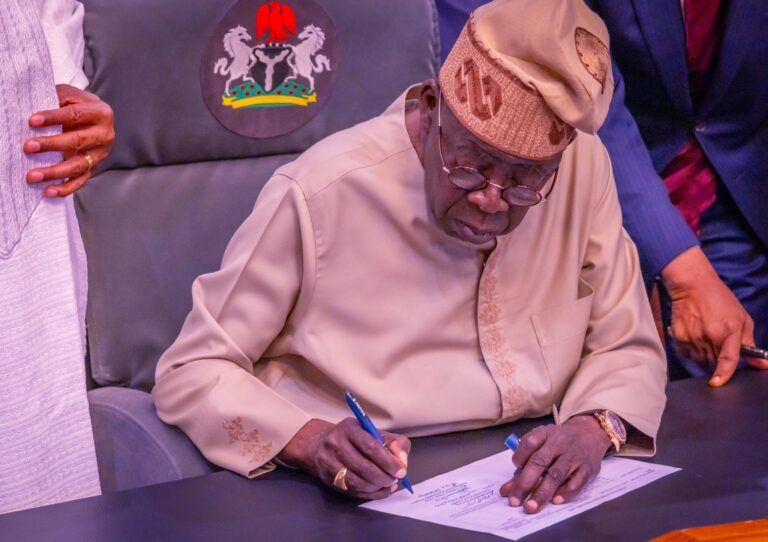
Nigeria’s President , Bola Tinubu has signed into law the 2026 Appropriation Bill, approving a total expenditure of ₦68.32 trillion for the fiscal year, extending the implementation of the 2025 budget to June 30, 2026.
This was disclosed in a statement made available to Newsmen on Friday by Tinubu’s Special Adviser on Information and Strategy, Bayo Onanuga in Abuja.
He noted that the newly signed budget reflects the administration’s fiscal priorities under its Renewed Hope Agenda.
A breakdown of the ₦68.32 trillion budget shows that ₦4.799 trillion is earmarked for statutory transfers, ₦15.8 trillion for debt servicing, ₦15.4 trillion for recurrent expenditure, and ₦32.2 trillion allocated to capital projects through the Development Fund.
According to the statement, capital expenditure accounts for about 50 per cent of the budget, underscoring the Federal Government’s commitment to infrastructure development, economic stability, and inclusive growth.
“The allocations reflect a strategic balance between statutory obligations, debt servicing, recurrent expenditure, and capital investments critical to driving productivity and improving the quality of life for Nigerians,” the statement read.
Tinubu also assented to the Appropriation (Repeal and Enactment) (Amendment) Bill, 2026, extending the capital component of the 2025 budget from March 31 to June 30. The presidency said the extension would enable Ministries, Departments and Agencies to complete ongoing projects and ensure optimal utilisation of funds.
“The extension will ensure the full and effective utilisation of appropriated funds, particularly for critical infrastructure and development projects at advanced stages,” the statement added.
The 2026 budget, which took effect from April 1, is titled “Budget of Consolidation, Renewed Resilience and Shared Prosperity.” It was initially presented to the National Assembly of Nigeria on December 19, 2025, with a proposed sum of ₦58.47 trillion, before lawmakers increased it to ₦68.32 trillion at passage.
During deliberations, House Leader Julius Ihonvbere highlighted key projections, including a 3.98 per cent GDP growth rate, a reduction in inflation to 14.45 per cent, and improved foreign reserves estimated at $47 billion.
Key sectoral allocations in the approved budget include ₦5.41 trillion for defence and security, ₦3.56 trillion for infrastructure, ₦3.52 trillion for education, and ₦2.48 trillion for health.
Tinubu, while directing Ministries, Departments and Agencies to ensure prudent utilisation of funds, emphasised transparency, value for money, and timely project execution.
He also commended the National Assembly for its cooperation in expeditiously passing the budget, reaffirming the need for sustained collaboration between the executive and legislative arms of government to achieve national development goals.
The President further assured Nigerians of continued fiscal reforms aimed at boosting revenue generation, stimulating economic growth, creating jobs, and strengthening social protection systems.