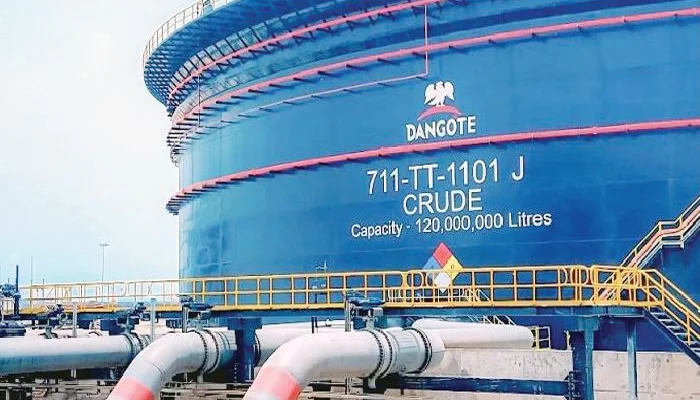
As a measure to check the rising fuel prices in the country, the Federal Government, through the Nigerian National Petroleum Company Limited (NNPCL), has begun plans to source crude oil from international suppliers to ensure steady production at the Dangote Petroleum Refinery in Lagos.
Sources say the NNPCL is leveraging its global crude trading network to secure third-party crude supplies for Dangote refinery in order to sustain domestic refining operations.
However, officials have warned that the intervention may not immediately reduce the cost of petrol for Nigerians.
Pump prices have continued to rise after recent adjustments pushed gantry prices from ₦774 per litre to ₦995 per litre. In some states, filling stations now sell petrol for as high as ₦1,200 per litre.
The development follows reports that the Dangote refinery temporarily suspended the loading of Premium Motor Spirit (petrol) due to supply challenges. The refinery currently receives about five cargoes of crude oil monthly from NNPCL, far below the 13 cargoes required under the government’s naira-for-crude policy.
The ongoing tensions between Iran and the United States have also pushed global oil prices upward, with Brent crude trading above $92 per barrel. The crisis around the Strait of Hormuz, a major oil shipping route, has further disrupted global supply chains.
Stakeholders said if the government fully implements the naira-for-crude policy and allocates more crude to local refineries, petrol prices could stabilise. They also noted that increased domestic refining capacity would reduce Nigeria’s reliance on imported petroleum products.
Data from oil market analytics firm Kpler shows that Nigeria’s imports of crude oil from the United States increased significantly in 2025, rising by over 160 percent compared to the previous year. Analysts say this trend highlights the paradox of Nigeria Africa’s largest oil producer increasingly relying on foreign crude to run its refineries.
Dangote refinery has expanded its distribution network, increasing the number of approved petroleum marketers from 13 to more than 30 companies nationwide in a bid to ensure wider fuel distribution across the country.