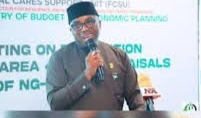
Secretary to Enugu State Government, Professor Chidiebere Onyia has called for for redesigning of educational Curricular in Nigeria as well as establishment of Boards for Curriculum review to develop inclusive and responsive curricula , guarantee ongoing auditing as well as detection and elimination of stagnant process and content.
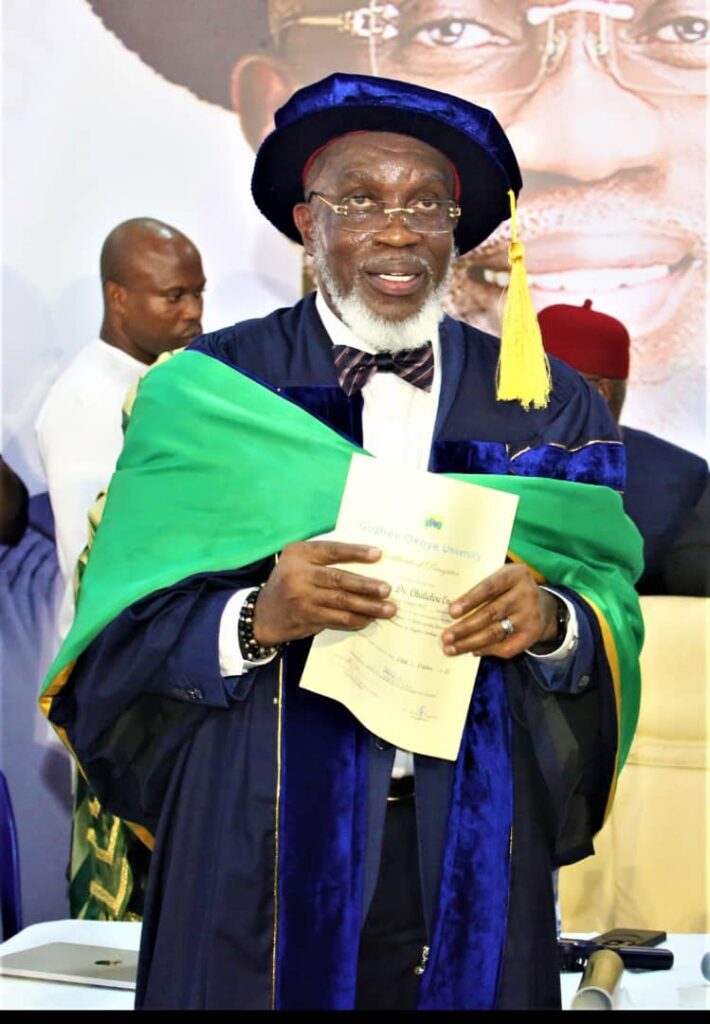
Prof Onyia displaying his 19Th GO-UNI inaugural lecture certificate
He made the call on Friday, 24Th October,2025 , while presenting the 19Th Inaugural lecture of the Godfrey Okoye University Enugu,Nigeria, on the topic, “Motion without Movement: A Retrospective introspection on Curricular Sedimentation in Digital Ontology.”
Onyia, a Professor of Curriculum and Instruction, said ,” the motion without movement concept describes the illusion of change , whereby surface solutions such as new programs or technology are incorporated into failing systems rather than addressing underlying inequities.”
He observed that Curricular sedimentation oppose change because they uphold hegemonic social norms that limit flexibility and inclusivity.
The 19Th Inaugural Lecturer noted that the Nigerian setting were sedimented by colonial and post- colonial cultures that restrict responsiveness to indigenous social needs by reverting to hierarchical administration and rote learning.
This sedimentation he said , ” produces movement without motion “, whereby reforms appear progressive on paper but fall short of upending established structures, reflecting disparities and disjointed knowledge system.
Prof Onyia
He said inorder to provide more equitable access to education , Curricular would need to be redesigned as adaptable and cohesive frameworks that encourage critical thinking and teamwork through digital capabilities.
Prof Onyia said digital ontology ,can integrate indigenous knowledge such as local practices and Universal perceptions to encourage relevance and inclusiveness.” Digital ontology enables interdisciplinary connections between different disciplines to enable learners to resolve complex problems through a collaborative exploration.,” he said .
He added that digital ontology relies on the moral basis because badly designed sites can automate compliance at the risk of Sedimentation rather than challenging it.”
Professor Onyia suggested ways to facilitate moral , transdisciplinary change in Nigeria and international context . He said Curricular need to be redesigned to accommodate interdisciplinarity and alternative knowledge systems., noting that through that way, students can effectively address complex societal issues, offer modules that would enable educators to create lessons that are completely and contextually coherent
He noted that “an iterative curriculum development process maybe made possible by regularly involving stakeholders through web platforms provide real-time feedback
To bridge the historical divide between policy and reality in administrative systems, and align digital ontology with transformative goals, Prof Onyia said, moral leadership is essential. “The leaders must implement open- data budgeting and procurement platforms inorder to achieve the alignment”.
Onyia cautioned that technology without ethical foundations merely digitizes corruption.
“Ethical leadership technology cannot be achieved simply by adding more rules to platforms,” he warned. “Digital systems must be deliberately designed to promote transparency, collaboration, and recognition.”
His team’s findings showed that digital procurement processes — when designed with built-in audit trails and multi-stakeholder review systems — significantly reduce subversion and manipulation.
He revealed that after introducing “ethical treatments” in the study institutions, the willingness to report misconduct increased from 1.8 to nearly 4.0 on a five-point scale, showing a substantial rise in confidence among participants.
“Integrity enhances operational efficiency,” Onyia noted. “Contrary to the belief that transparency slows processes, we found it actually reduces delays caused by corruption and obstruction.”
In what he described as a “critical awakening,” Professor Onyia said teachers who participated in intervention programmes became more open to challenging outdated teaching models.
“Over 15 percent of the teachers exposed to the reform disagreed with traditional methods, compared to less than 1 percent in the control group,” he stated. “This shows that ethical and digital interventions can trigger a mindset shift — the true beginning of transformation.”
He emphasized that genuine reform must move from hierarchical compliance to collaborative agency, where educators collectively challenge entrenched practices and develop reflective, community-based solutions.
The lecture highlighted a meta-framework developed from 20 years of research, identifying four interconnected barriers to education reform such as Systemic Support Deficit, Pedagogical Misalignment, Faculty Capacity Gap and Technological Integration Challenges.
According to Onyia, these challenges reinforce each other, meaning that addressing one without the others leads to a relapse into outdated, lecture-based systems.
He therefore recommended simultaneous, systemic interventions built around two key levers of change by redesigning Curricula for Transdisciplinarity and nsuring Equity and ImpactHe called for integrating local knowledge systems and global challenges into curricula, using digital tools to create modular and flexible learning experiences.
“We must move from isolated disciplines to collaborative hubs where engineering, ethics, and public policy meet to solve real-world problems,” he proposed.
Onyia urged policymakers to ensure that digital reform promotes inclusion rather than automation. He advocated for digital tools that accommodate rural contexts, genuine stakeholder collaboration, and evidence-based evaluation frameworks that measure learning beyond test scores.
“We must use analytics to assess how students apply knowledge to real-life community challenges, not just how they perform in exams,” he stressed.
From Sedimentation to Transformation
In his concluding remarks, Professor Onyia underscored that technology is not a savior without ethical leadership and systemic coherence.
“Digital tools without ethical leadership only make inefficiency look efficient,” he said. “Ethical leadership without digital leverage remains trapped in bureaucracy. And digital reform without a new ontological framework creates a vacuum.”
He described this imbalance as “motion without movement,” urging Nigerian educators and leaders to pursue synchronized reform — combining ethics, technology, and inclusivity to achieve lasting transformation.
“Our task,” he concluded, “is to move from sedimentation to transformation — from mere activity to true progress. Only through ethical leadership, systemic collaboration, and digital inclusivity can we achieve movement that truly matters”, Prof Onyia said.
Fmr Gov Ugwuanyi (L) Fmr Deputy Gov Ezeilo( R)
He also suggested enhanced professional development to enable educators implement transdisciplinary and ethical reforms; collaboration and use of digital tools to create flexible and inclusive learning environment as well as efficient evaluation procedures to track the advancement of reform and elimination of resource disparities go initiate equitable change.
In an interview , the Special Adviser to the Governor on Legal Matters, Hon. Osinachi Nnajieze, Esq. lauded Professor Onyia for the inaugural lecture lecture.
He said, “I am a lawyer, so when you talk about retrospect and introspect you know, you are comparing, relating the past with the future through reflection. And that’s what he has done here today on curriculum. How it is designed and how they are implemented and how they should be driven by the ultimate goal of the society. Where the society wants to be, should be reflected in what students have been taught. “
He explained that the intended learning outcomes of every unit, of every teaching programme should reflect the goals and the vision of the society.
” That is apt. It connects to all the problems of this country. All of them. It is how the foundation that we lay for the philosophical, intellectual and behavioural upbringing of children and even adults who are in the university, should be.
“Again, that links up to what we are doing in Enugu State. Which the SSG himself proposed to. It is in the heartbeat of the Governor’s agenda. Driving and steering it in the right direction.So, the SSG holds the delivery units of the Governor together and shows that what the Governor wants done is delivered to the letter,” he said..
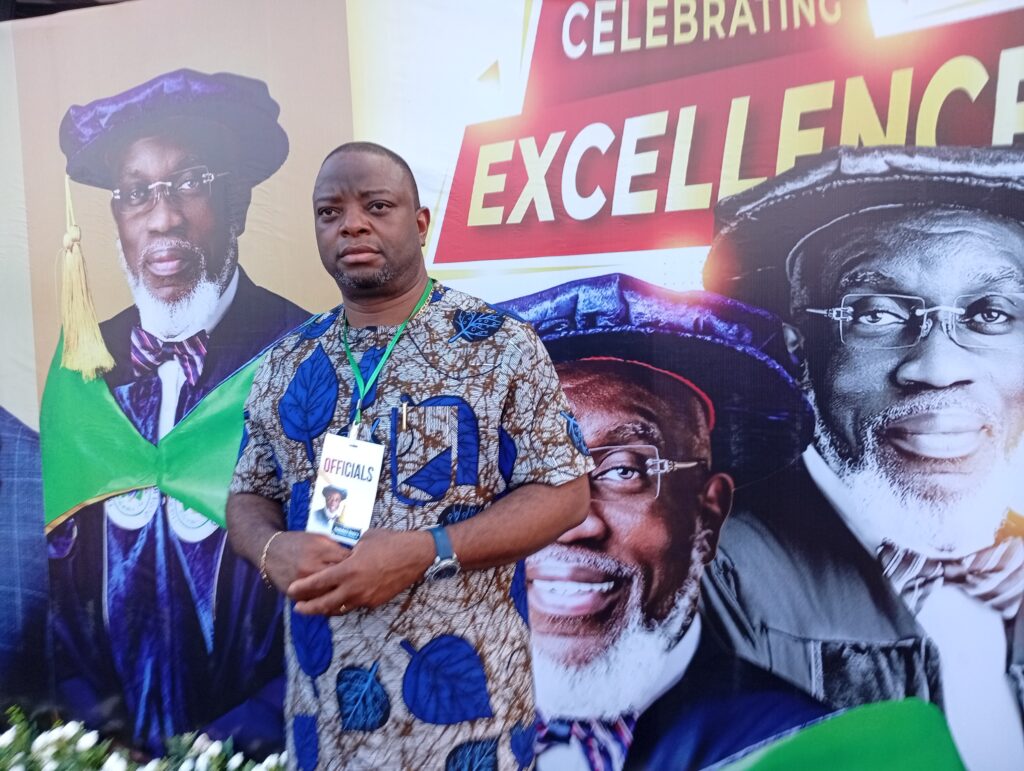
Commending Prof Onyia, the Special Adviser said, ” it’s wonderful seeing that he understands, he has the theoretical underpinning of the things that he is doing. Administratively, politically and in the management of the team, of the Governor’s team. Then on the man himself, he’s someone that I met when I got into this job and he’she’s proved himself in every way, in every sense.
” The way he leads, the way he holds people accountable, the way he drives the agenda. The clarity of the instructions from him and the understanding that he has.It’s almost as if he was with the Governor, when the Governor envisioned what he wants for the State. But I know he wasn’t there. The fact that he understands it so well, says a lot about him”, Nnajieze said..
Also speaking with newsmen, the Chairman of Ezeagu local government area,Hon Vitalis Ndu, on his part, commended the SSG for the lecture
He said the knowledge gained will help stakeholders, especially educational policy makers in designing and implementing educational curriculum that will provide answers to the needs of the society.. He said they will apply the knowledge gained at the locality.
Highlight of the inaugural lecture was the presentation of the 19th inaugural lecture certificate to Prof Onyia by the Vice- Chancellor of the Godfrey Okoye University,Enugu, Nigeria, Rev Fr Prof Christian Anieke.
The event which had prominent people from different walks of life, the academia, political class traditional rulers, the religious had the former Governor of Enugu state Rt. Hon. Dr. Ifeanyi Ugwuanyi, the former Deputy Governor, Hon. Mrs Cecilia Ezilo, the Deputy Governor of Enugu state, Ifeanyi Ossai, the Obi of Onitsha, HRM Igwe Nnaemeka Achebe,