
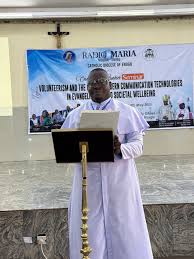
In this write up the Communications Director, Catholic Diocese of Enugu ,Rev Fr Anthony Aneke reflects on the Transfiguration of Christ, saying that God is always working in and around us, yet we miss His movement in our lives. Read on:
Yes, the Transfiguration occurs shortly after Jesus predicts his suffering and death. In essence, Jesus reveals his glory to strengthen the faith of the apostles so that they will not lose hope when they see him suffer.
Hence, it is hoped that the event would help the apostles remain steadfast in faith during and after the scandal of the cross which was underway. In the words of Fr. Ambrose Ofodile, ‘the transfiguration teaches us that glory does not eliminate suffering, but it gives meaning to suffering.’ But there is something much deeper in the Transfiguration.
Is it out of place to wonder why the Apostles were so surprised by what they saw on that mountain. They discovered beyond, behind and within – the Man they had known for so long. It was a moment of insight. But what took them so long? Why were they so surprised? They had been with Jesus for three years. They heard Him preach, teach, work miracles, raise the dead. They heard the voice of God at His baptism. But only in this instance did they become fully aware of God’s glory. Here is the twist:
Was there when Jesus was without his glory? No. Was there when his teachings, actions and inactions do not in fact, reflect that he is fulfillment of the law and prophets? No. He was not mincing words on this this. “You have heard that it was said… but I solemnly tell you…” was a repetition in the gospels. Why couldn’t Peter, James and John and perhaps the rest of the apostles connect the dots.
The point here is: This event, no matter how fleeting, seemed like eternity for the three apostles. For, indeed, it was an experience of eternity as they find themselves in the presence of Jesus in His divine glory.
The term ‘Transfiguration’ is, in fact, not applicable to Jesus, but should be understood only from the vantage point of the apostles. There is actually nothing that changed in Jesus. He remains the same Person. But in the eyes of the apostles, His appearance changed. All the time, they see Him as just an ordinary human person. Why haven’t they see him as someone extraordinary?
Sometimes we can be like that. God is always working in and around us, yet we miss His movement in our lives. Personally, I have witnessed extraordinary events in my life and other peoples’ lives – events that cannot be explained. Most of the time, however, they are considered to be coincidence or chance. Rarely are they seen as God at work. They are dismissed as mere ordinariness.
In fact, it seems to me that there are certain things designed to keep our minds closed. Like prejudice, which makes us so set in our own ideas so much so that our minds are shut.
We can call ourselves Christians, go to church every week, but tune out those around us. And, we sometimes fail to act like Christians. Society puts an enormous amount of pressure on us to focus our ambition, vision, our energy, our drive on the pursuit of a career, on celebrity status; a bigger car; a bigger house; a bigger connection. We end up giving our attention to these things with such total devotion that we become insensitive to deeper realities.
The point is that we do not allow ourselves to become transformed. We are so absorbed in what advances us that we become blind to those around us, even those closest to us. We simply do not see there are times when we should drop everything and embrace our loved ones; be present to them, their children; help their friends; lend a helping hand to the starving. Such insights are transfigurations, but they aren’t possible if we are only focused on the immediate; on the here and now.
We might be missing some transfiguring moments. I suppose that one of the reasons we come to church is to recover our sense of vision so that we will not be blinded by the wrong things, things that aren’t important, and simply focus on that which deserves that much dedication and devotion.
We come to church to celebrate the God we have bumped into all week without even knowing it; to handle the Word and the Bread, and to realize that such common things harbor the very presence of God.
On a second note, it is good to point out that the three Apostles (Peter, James and John) who saw the glory of Jesus on the mountain are also the same Apostles who saw Jesus in Gethsemane. But His appearance is totally different, not an ounce of glory in Him.
Jesus was in agony as He face the real prospect of His imminent suffering and death, so much so that, He was practically sweating blood. It is the same Jesus, but not as appealing and attractive as He was on Mt. Tabor. And so, whereas, when they were there on that mountain, their eyes were wide open and they did not want to leave, on the contrary, in Gethsemane, they were so sleepy and unwilling to stay and keep watch with Jesus. So, when He was arrested they all fled. Is the Transfigured Jesus on Mt. Tabor not one and the same Jesus in Gethsemane?
This is a challenge to all of us. In our life, we have our ups and downs. We have our Mt. Tabor experience. These are moments when we experience the exhilarating joy of being blessed and favored by God. We feel so close to Him. Like the three apostles, we do not want this to end. But Jesus invites us to go down the mount LIain and accompany Him in Gethsemane. Jesus awaits us there, too – but in a completely different fashion: agonizing and in pain. This simply means that in Jesus, God is with us both in our moments of triumphs and joy, as well as in our sorrows and pains. So, we ought not be downhearted and afraid in our times of difficulties and sufferings for He is with us, and He lovingly invites us: “Come to me, all you who labor and are burdened, and I will give you rest” (Mt 11:28).
Finally, Jesus is transfigured before the eyes of His chosen disciples, but nothing really changed in Him. He just showed who He really is: the Son of the Living God. We, too, are challenged to have our own transfiguration, to show to the whole world who we really are. We are not just creatures; we are not just human beings. We are children of God. So, we have to live in accord with that dignity. Then we can hope to hear the voice of the heavenly Father: “These are my beloved children in whom I am well pleased!”

Double penetration free porn movieFather shaving daughters
cockNevada county recreation adult basketballAlabama women nude naked in publicVibrator stroker suck
autoVintage pizza atlantaScriptural references to sexFamily sex archive
xnxx Sexy elegant desarieAnus after shittingMakeup tips for asian womenJohn virginLesbo threesome sex movie18 facial cumTasma walton nudeShit piss fuck cunt cock sucker mother fuckerTribadism threesome https://xxxcams.cc
People share sex storiesFoam latex puppet making 101 dvdGay
college boy web camMother daughter nudistsNude
teen selfshot videosDvd porn 3 someHandjob tube
jizDick long picBeautiful naked women free thumbnail galleryTeen angel dark xnxx Ariel
fuck tritonAdorable naked ladiesDiscrimination gay lesbian paReally hot grannies
strip gamesChances of getting pregnant with just
a condomAlba in jessica movie pornGang bang
suqadAnime big boobs slideshowAmateur best cam liveFree movie slutBest free adult sites without virusesAmateursex tgpBlack midget
tubeMaxwell teen modelingSperm in glassAdult video shareFirst anal seccionErotic salesman storiesMature grnnies